If you’ve ever wanted to bootstrap a business, you’ve probably felt the temptation to do it the “exciting” way. Build the product. Invest in the platform. Perfect the tech. Go big fast.
But John Arrow has lived the other side of that story, the side where building too early, scaling too fast, or chasing the wrong customers can quietly destroy your margins, your time, and your sanity.
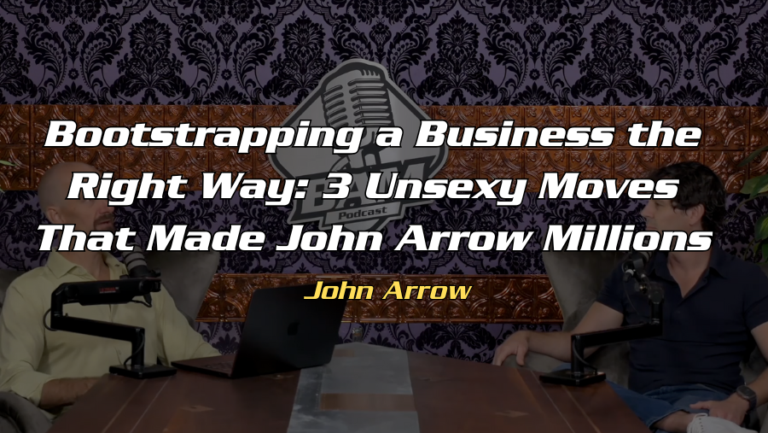
John Arrow is the CEO of FreedomGPT and a General Partner at Age of AI, where he builds and invests in companies at the forefront of artificial intelligence. His work spans founding, scaling, and backing businesses focused on emerging technologies and long-term impact. Previously, John bootstrapped Mutual Mobile from an early idea into a 300-person mobile product development firm before a successful exit to a public company. His work has been recognized by Forbes’ Most Promising CEOs Under 35 and Inc. Magazine’s 30 Under 30.
And in his Beyond A Million episode, he drops three tactics that sound almost too simple until you realize they’re exactly what separates founders who build real businesses from founders who just build “projects.”
If you want to hear the full conversation, you can listen to the complete episode here:
Now let’s break down the three moves that can completely change the way you think about bootstrapping a business.
Bootstrapping a Business Means You Don’t Earn the Right to Build Tech Until You Prove Revenue
This might be the biggest trap founders fall into when they’re trying to bootstrap a business, especially a tech business. They build first because it feels like progress. It feels like momentum. It feels like you’re “being legit.”
But John’s approach is the opposite, and it’s brutally practical.
He says, “I’m always the last to say, ‘Let’s add technology. Let’s do it this slow, unsexy way, prove the revenue, and then come in with the tech.’”
Read that again. Slow. Unsexy. Prove revenue. Then build tech.
John gives an example of a company that did exactly this, and it’s almost painful how simple it is. He says, “They operated like this for a year before they started writing a line of code.”
That one sentence contains a blueprint most people ignore.
Because when you’re bootstrapping a business, you’re not just building a product. You’re buying time. You’re buying optionality. You’re protecting yourself from sinking months into the wrong thing.
So instead of thinking, “What product do we build?” the better question is, “How do we deliver the outcome manually so we can prove people will pay?”
If you can do it manually for your first customers, you have proof. If you can’t do it manually, you probably don’t understand the real problem yet anyway. And that’s exactly what kills most bootstrapped businesses, building complexity before you’ve earned demand.
Bootstrapping a Business Gets Easier When You Stop Serving Everyone
Most founders assume that the way to grow is to say yes to everything. More customers equals more revenue. More accounts equals stability. More logos equals credibility.
But John learned the hard way that saying yes to everyone is how you end up drowning in low value work while thinking you’re “growing.”
He tells a story from Mutual Mobile when they had hundreds of customers and everything was chaotic. And then he says the line most founders would never say out loud.
“We ended up firing nearly all of our customers.”
That is a terrifying move when you’re bootstrapping a business. It’s the kind of decision that forces you to stare straight into your real confidence level. Are you confident enough that you can replace these customers with better ones, or are you just hoarding revenue because you don’t trust yourself?
John and his team decided to draw a hard line in the sand and only work with big spenders. As he puts it, “We would only work with companies that had a spend of at least a million dollars a year with us.”
Then he describes what happened after, and this is the part every founder dreams about.
“That’s when the profit just skyrocketed, the headaches went down…”
That’s not just an operational improvement. That’s a strategic unlock.
Because bootstrapping a business is not just about getting customers. It’s about getting the right customers, the ones who pay enough to let you do your best work, and who don’t force you into the kind of messy, low trust, high drama dynamics that come with cheap contracts.
If you want to bootstrap a business successfully, you have to treat customer selection like product development. Your business becomes what you tolerate. And if you tolerate tiny accounts that drain your team and stall your capacity, you’re not building a business. You’re building a treadmill.
Bootstrapping a Business Requires Profitability From Day One Because You Can’t Time the Market
A lot of founders justify their chaos with one assumption.
“We’re early.”
“The market isn’t ready yet.”
“Once adoption catches up, we’ll be fine.”
John has seen that story play out too many times, and he doesn’t sugarcoat what happens when you hang everything on timing.
He says, “You can’t time the market exactly. So, make sure you’re building something from day one that can support some type of profitable growth.”
Then he follows it with the reason most people ignore, because it forces you to face reality.
“Because you don’t know how long you’re going to need to wait…”
That’s the truth.
If the thing you’re building requires the world to change for you to survive, you’re not bootstrapping a business. You’re gambling.
Bootstrapping is about controlling your destiny. It’s about designing a model that can produce profit and progress now, even if the future is uncertain.
And the best part is this does not mean you have to abandon the big vision. It just means you have to pair the big vision with a cash engine. Something that keeps you alive while the bigger market catches up.
Because growth without profit is a privilege. When you bootstrap a business, you don’t get that privilege. You earn it.
The Real Secret to Bootstrapping a Business Is That It’s Supposed to Feel Unsexy
Here’s what makes John’s advice so powerful. None of it is glamorous.
It’s slow. It’s disciplined. It’s deliberate.
It’s proving revenue before building tech. It’s cutting customers who don’t fit. It’s refusing to rely on timing.
But it works, and the reason it works is because it builds a real business, not just a promising idea.
So if you’re bootstrapping a business right now, and you feel like you’re behind because you’re not building fast enough, ask yourself a better question.
Are you building fast, or are you building smart?
Because the founders who win long-term are almost always the ones who do it “the slow, unsexy way,” prove the revenue, and then scale what actually works.
And if you want to hear the full story and everything John shared about building and exiting Mutual Mobile, make sure you listen to the full Beyond A Million episode.