How to Build Business Automation That Actually Grows Your Company
Most entrepreneurs hear “business automation” and immediately think about software tools, CRMs, or the latest AI platform. That’s exactly where most people go wrong.
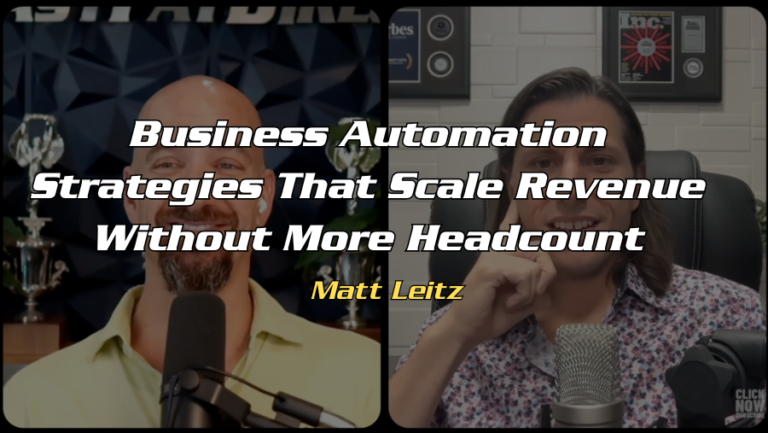
Matt Leitz is the founder of BotBuilders and one of the early pioneers of large-scale business automation, long before mainstream AI tools existed. He’s built and operated multiple 7- and 8-figure companies, implemented complex automations for brands doing nine figures, and helped entrepreneurs scale by combining systems, AI, and human performance. Over the past two decades, Matt has developed automation frameworks, AI agents, custom GPT workflows, and high-performing sales systems that continue generating revenue years after being built. He’s also consulted for major companies like Cardone Ventures while continuing to scale his own fast-growing businesses.
And according to Matt, if you’re starting automation with technology, you’re already behind.
As he puts it, “Where you start is by not focusing on the technology.” That single mindset shift explains why some automations quietly generate revenue for years while others never move the needle.
Business Automation Strategies Start With Outcomes, Not Tools
One of the biggest mistakes businesses make is letting software features dictate their strategy. Matt argues that automation should never start with a platform demo or a tool comparison.
Instead, he recommends something far simpler: “Pulling out a dang notebook, going to the whiteboard, and really just kind of penciling out what is it that we’re trying to achieve.”
At its core, Matt believes automation should always support just three business outcomes. “There’s three things that really matter… how are you going to generate more leads? How are you going to make more sales? And then, how are you going to better support your people?”
That framework forces clarity. When you know which of those three levers you’re pulling, automation stops being theoretical and starts becoming practical. Every workflow, AI agent, or system exists to directly improve one of those outcomes. Anything else is just noise.
A Simple Business Automation Strategy That Books Appointments on Autopilot
One of Matt’s favorite examples of effective automation isn’t complex or flashy. It’s simple, repeatable, and quietly powerful.
He describes adding a single follow-up touchpoint: “Let’s add a text message on the third day… ‘Would it be of value to you to set up an appointment with one of my best people?’”
The magic happens in what follows. “And the response just triggers an AI, and the AI books an appointment.”
That’s it. No complicated funnel rebuild. No massive tech stack overhaul. Just one well-placed message paired with intelligent automation.
Why this works so well is longevity. As Matt explains, “That thing can run for years, and you’ve now got appointments that are being booked on autopilot.”
This is the type of business automation strategy that compounds over time. You build it once, and it keeps producing results long after you’ve forgotten about it.
Why Smart Business Automation Depends on the Right Offer Structure
Automation doesn’t fix a broken offer. Matt is blunt about this, and he sees it as one of the most common reasons automation fails.
When he talks about offers, he’s not just talking about price. “When I say an offer, I’m referring to the pricing, the packaging, the positioning, the process, and what you’re selling it and who you’re selling it to. I call it the five Ps.”
In Matt’s framework, not all offers should be marketed equally. “Whatever your first thing that you go to market that you’re spending marketing money on is your lead offer. All your other offers are maximizer offers.”
Automation works best when it supports a clear lead offer that brings people into your ecosystem, followed by maximizer offers that increase lifetime value. Trying to automate multiple front-end offers at once usually creates confusion, not scale.
And the decision of which offer should lead shouldn’t be based on gut instinct. As Matt puts it, “Probably the number one mistake that entrepreneurs make… ‘I think that this will work.’ No, just pencil it out.”
His rule is simple and unforgiving: “If you can’t make it work on paper, you can’t make it work in the real world.”
The Real Power of Business Automation Strategies
What makes Matt Leitz’s approach to business automation so effective is that it’s grounded in reality. Automation isn’t about replacing humans or chasing the newest AI trend. It’s about building systems that support proven business fundamentals and letting them run consistently.
When you focus on outcomes instead of tools, design simple automations that compound over time, and anchor everything to a mathematically sound offer, automation stops feeling risky. It becomes one of the most reliable growth levers in your business.
That’s how systems built years ago are still generating revenue today — without constant oversight, without more headcount, and without burning out the team behind them.
Want more strategies like these from 7-, 8-, and 9-figure entrepreneurs? Subscribe to the Beyond a Million newsletter and get the exact insights top founders use to scale smarter and faster.