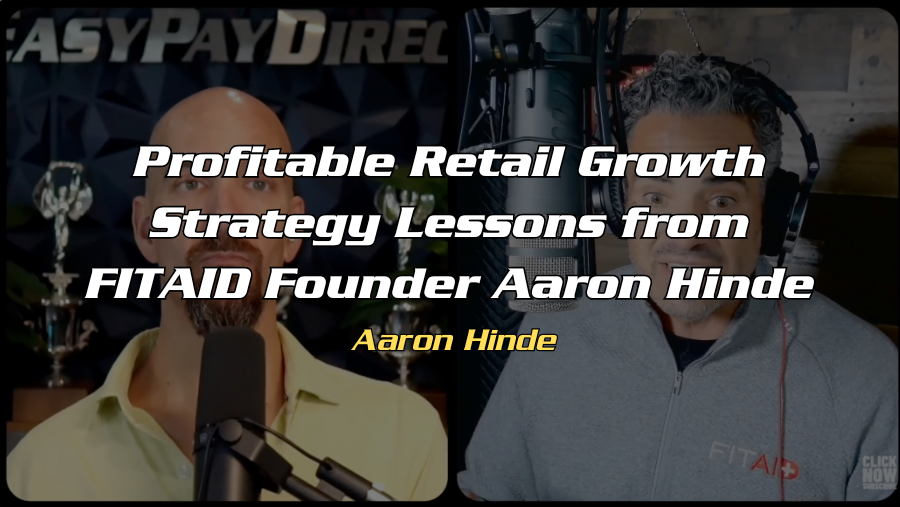
Most founders chase retail expansion thinking scale automatically equals success. More doors, more distribution, more revenue. But Aaron Hinde learned the hard way that growth without discipline can quietly destroy a business.
Aaron Hinde is the co-founder of FITAID, one of the first functional beverage platforms in the U.S. and the first brand to bring a nootropic drink, FOCUSAID, to market. Since 2011, Aaron and his partner Orion have grown FITAID into a multi-eight-figure company valued at over $100M, stocked nationwide and deeply rooted in CrossFit and functional fitness communities. What makes the story more compelling is that Aaron left a thriving chiropractic practice to enter an industry where 95% of brands fail in their first year—and came dangerously close to losing everything more than once.
That experience shaped a very different view of growth. Not hype-driven growth. Not vanity revenue. But a profitable retail growth strategy built on discipline, relationships, and brutal honesty with the numbers.
Profitable Retail Growth Strategy Starts With Contribution Margin Reality
One of the biggest mistakes brands make is assuming that if a channel is producing revenue, it must be working. Aaron learned that assumption can cost millions.
As he puts it, “Pay close attention to… your contribution margin per channel. You got to bake in not only your cost of goods, but the box costs, the shipping costs… my warehouse costs, my site costs.”
This wasn’t theory. It was a painful lesson learned in real time. When FITAID finally broke down the true cost of a large retail relationship, the result was shocking.
Aaron explains, “We looked at what they were billing us back… and you realize, ‘Wow, not only am I not making money, but it’s costing me a million dollars a year to have a relationship with this retailer.’”
That moment reframed everything. A profitable retail growth strategy doesn’t optimize for revenue. It optimizes for contribution margin after every hidden cost is accounted for. If a channel looks impressive from the outside but bleeds cash internally, it’s not growth—it’s erosion.
Profitable Retail Growth Strategy Requires Relationship Equity, Not Just Distribution
Retail is not purely transactional, and Aaron is adamant about this point. Long-term success depends on how much relationship capital you’ve built before things go wrong—because eventually, they will.
“Everybody has an emotional bank account,” Aaron says. “You’re either making an emotional deposit or withdraw. There are no neutral interactions.”
This mindset became foundational inside FITAID. Whether dealing with retailers, partners, or internal teams, Aaron focused on consistently building surplus goodwill.
“The key is to make enough deposits that you’re not just at zero—you need that emotional bank account at a massive surplus,” he explains.
That surplus doesn’t come from grand gestures. It comes from intentional consistency. Aaron points out that it’s often “doing a lot of the little things… handwritten notes or little gifts or going the extra mile” that create durability when challenges hit.
In a profitable retail growth strategy, relationships are not a soft skill. They are an insurance policy.
Profitable Retail Growth Strategy Comes From Going Deep, Not Wide
Another counterintuitive lesson Aaron learned is that trying to appeal to everyone almost always backfires. FITAID didn’t win by chasing every demographic. It won by committing fully to one.
“Choose a single target market, go deep in that market, and be authentic to that market,” Aaron says.
That authenticity wasn’t manufactured. FITAID embedded itself inside the CrossFit and functional fitness communities because it was genuinely part of them.
“You can’t just pay your way in,” Aaron explains. “It’s not just because you think there’s a big opportunity there, but truly like, ‘Hey, I eat, breathe, sleep… I’m part of this community.’”
This focus allowed FITAID to build trust competitors couldn’t buy. From there, expansion became easier because it was built on credibility, not ads alone.
Why This Profitable Retail Growth Strategy Still Matters Today
Aaron’s story is a reminder that sustainable success doesn’t come from chasing scale at all costs. It comes from understanding your numbers deeply, protecting relationships intentionally, and building from a place of authenticity rather than ambition alone.
A profitable retail growth strategy isn’t flashy. It’s disciplined. It forces hard decisions, uncomfortable exits, and patience most founders don’t want to practice. But as FITAID’s journey shows, it’s also the difference between a brand that burns bright and fast—and one that lasts.
Want more strategies like these from 7-, 8-, and 9-figure entrepreneurs? Subscribe to the Beyond a Million newsletter and get the exact insights top founders use to scale smarter and faster.